


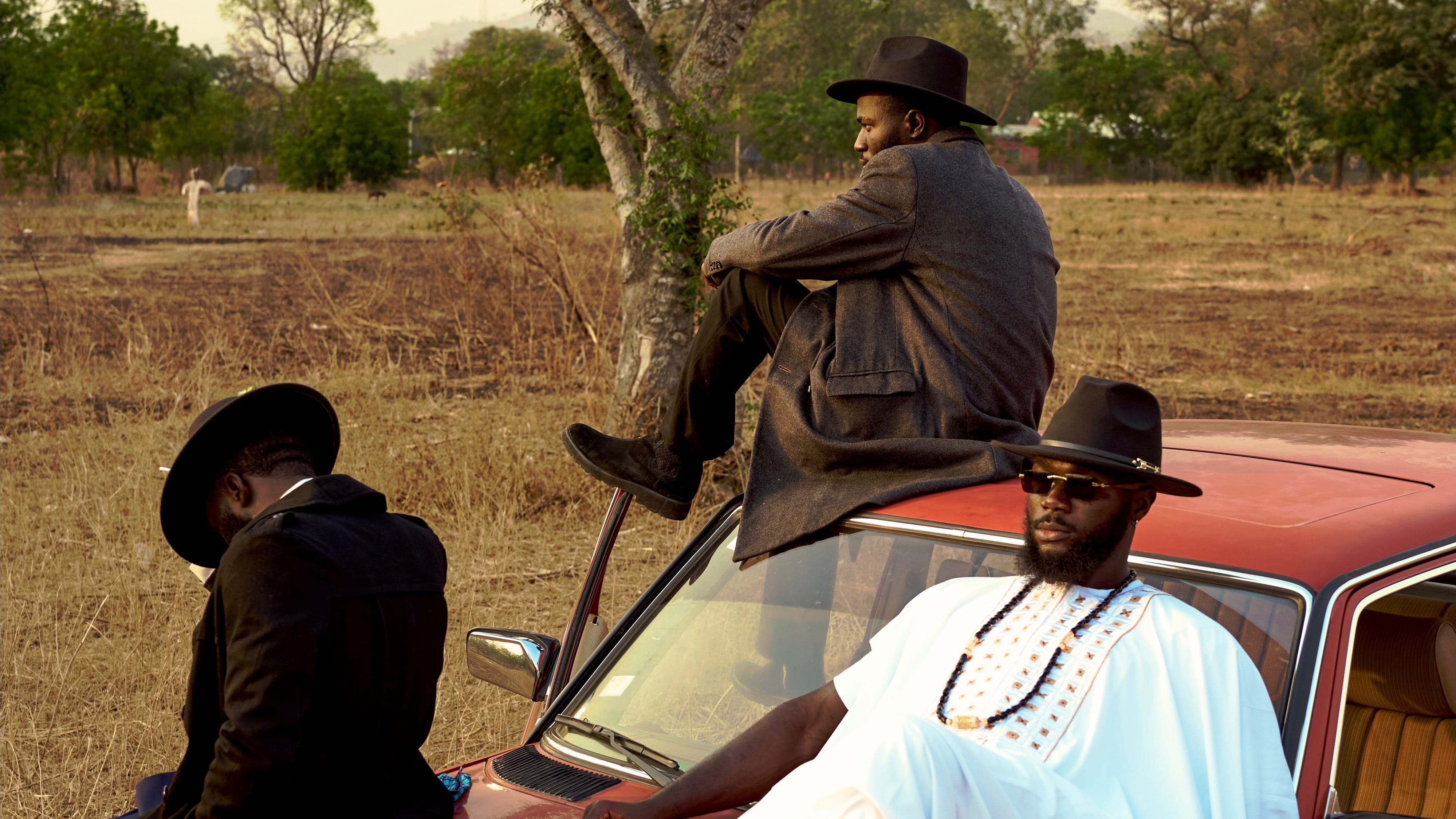
The photograph looks like a still from a film that does not exist. Golden hour somewhere outside Abuja: a vintage red Mercedes parked in dry savanna grass, three men draped over it in hats and white agbada, nobody smiling, everybody certain. There is no such movie. There is only a photographer who believes his country deserves to be seen this way, and a generation willing to stand in the frame.
The photographer is David Sani “Enrico”, and the frame is THE NEW VANGUARD, his Season 6 Artizen project: a cinematic archive of Nigerian identity, built as a physical exhibition and a permanent onchain record, with workshops that teach the creatives around him how to keep what they make. His pitch calls it “a permanent historical record, built to keep our raw emotion and fashion safe in a digital space that lasts forever.”
He recorded his impact interview the way he shoots: in one take, no script. “I’ll just record this live so it flows as it is,” he says near the end, and it does. It is worth watching.
David recorded his Season 6 impact interview in one unscripted take from Abuja.
A Small-Scale Artizen
Ask David what he is making and he does not start with the exhibition. He starts with the machine behind it. “Think of like a small scale Artizen,” he says, “for photographers and creators first.” A decentralized platform where photographers “can come and study, share their work, gain visibility,” and, the line he leans on hardest, “not have to depend on doing the commercial aspect of photography… to be able to chase photography and creativity the way they want.”
That dependence is not an abstraction to him. It is the shape of his own career. He has spent more than five years inside the Abuja Photo Festival community, documenting Capitol Film Fest, AWG Fest, and the city’s creative scene, while working as PR officer and content producer for The Greatest Collective, the group that calls itself Abuja’s number one art community. It was the Collective’s founder, Crosswordz David Ikani, who introduced him to Artizen. “The whole thing felt so right to me,” he says.
“I’ve faced the struggles and still facing the struggles. And I know the problems, I think I have solutions to the problems.”
He is candid about his qualifications in a way grant applications rarely are. “I might not be the perfect match, but I mean, I’m an experienced person, I’m here, I live here, I’m hands-on,” he says. “I’m willing to take the risk to solve these problems, to help my people, to help the younger generation coming up.” This is a generation documenting itself, not waiting to be discovered.
Portraits from a Film That Does Not Exist
The sample photographs David envisions for the inaugural exhibition read like production stills from a Nigerian film that does not exist. A couple in red and green aso-oke and coral beads, posed against still water. A studio portrait of a man with gold trinkets pinned to his cap and a red pipe in his teeth, lit like a Rembrandt. Two models standing in a maize field under a flat grey sky. A staged tableau of a warrior with shield and sword outside a thatched hut.


One of these images already lives on Artizen: “Pioneer,” his Season 6 artifact and one of the photographs envisioned for the inaugural exhibition. The rest are proof of a visual language, cinematic, saturated, formal, that treats contemporary Nigerian identity as something worth composing carefully rather than capturing incidentally.
“I see the culture in real time and I want to document this culture in real time and I want to showcase it to the world.”
The behind-the-scenes footage tells you what the finished frames cost. In one clip, two women wade waist-deep across a river, one balancing an upturned red plastic stool on her head, carrying the set to the shot.
Carrying the set across the river for the aso-oke portraits.
Everybody on Set
Season 6, by David’s own account, was the season THE NEW VANGUARD stopped being an idea. He traveled to the IRIN AJO exhibition in Abuja and documented it, studying “how immersive cultural experiences are designed, presented, and experienced” and meeting its organizers, curators, artists, and set designers. He scouted locations, drafted the platform blueprint in his notes, and consulted his cousin, web developer Sani Collins, on what it would take to build.
He kept photographing: festivals, album covers, other creators’ Artizen projects, including HERITAGE COLLECTION, whose founder encouraged him to bring his own project to the platform.
“We’ve made progress,” he says. “I’ve made networks with the creators, set designers, curators, everybody that’s on the sets and everybody that’s putting the whole thing together. So once we are ready for the next phase of production, we go straight into shooting.”
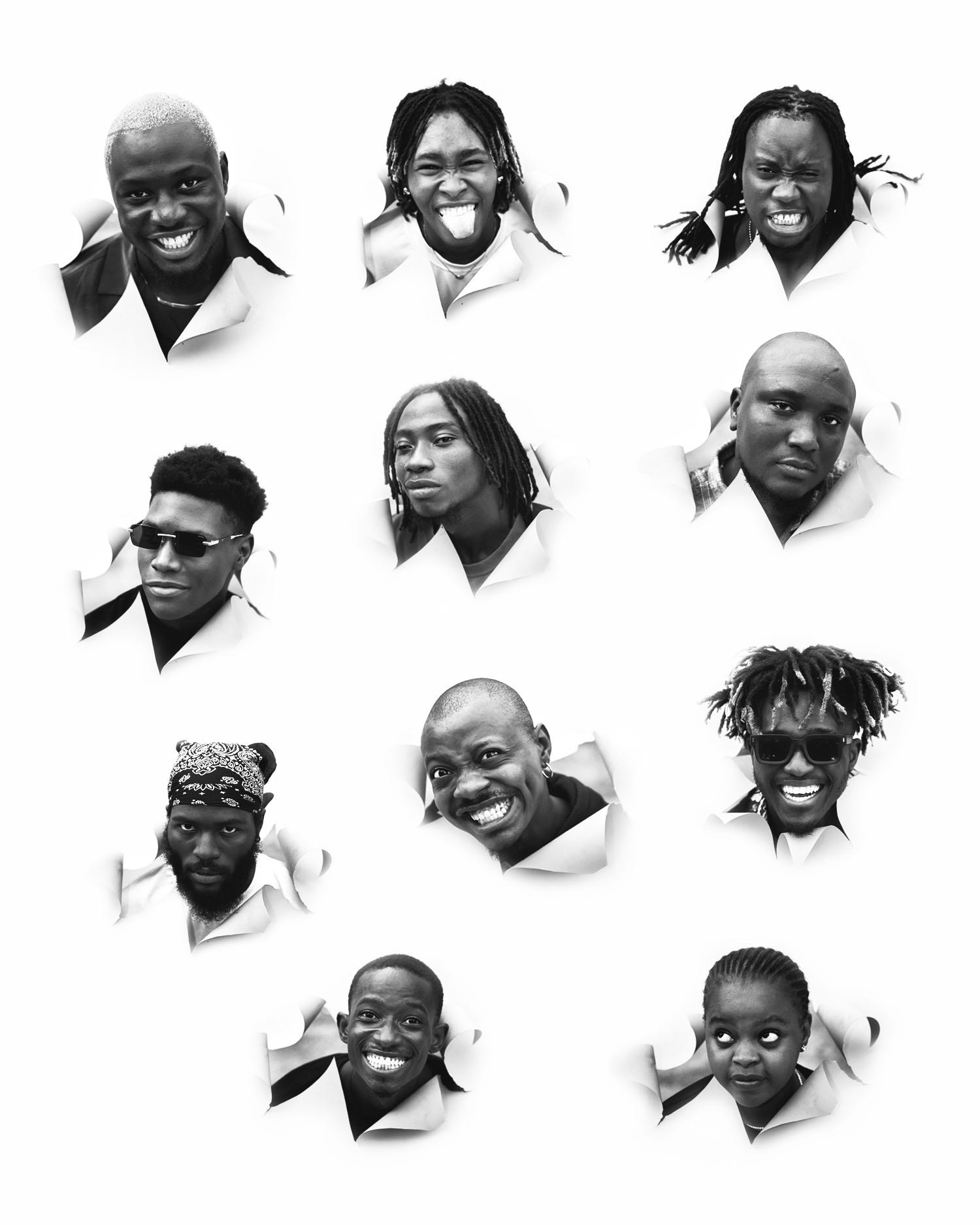
The community is not set dressing. Beke, who bought his first camera and speedlight in 2020, then returned five years later to make THE NEW VANGUARD’s first artifact purchase; Earl Joey, who backs the project with money and ideas; the Collective that gave him a role and a room.
The biggest lesson of the season, he wrote, is that “meaningful cultural projects are built through consistent engagement with people and communities.”


What the Money Builds
THE NEW VANGUARD by the numbers. The project has raised $7,535 on Artizen across two seasons, a quarter of its $30,000 goal. Season 6 brought $6,825: $2,265 in artifact sales, $900 in unlocked match funding, $1,605 in matches from curating funds, $2,025 in boost awards, and $30 in prizes.
For a self-funded photographer in Abuja, that is not a rounding error; it is the difference between an idea in a Notes app and a production calendar. The money buys the next phase he describes on camera: the shoots, then the exhibition, then the workshop where attendees learn to mint and hold their own work.
“I’ve got an idea and I feel like I’ve got to share this idea with a whole lot of people and I need a little bit of resources to fund it.”
The Rock on the Horizon
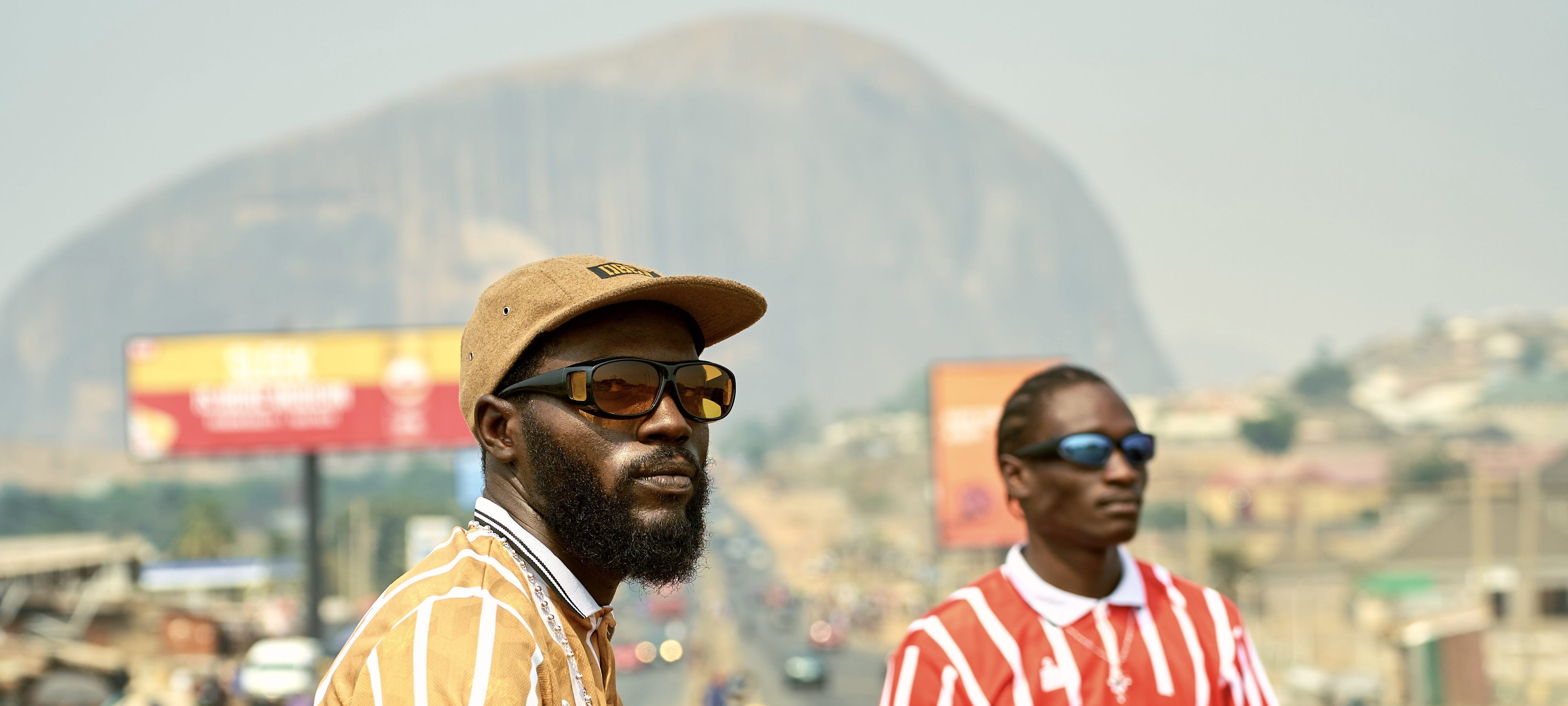
There is a photograph in his set that carries the whole argument. Two young men in striped football jerseys and sunglasses stand on a highway median, and behind them, hazed by distance, looms Zuma Rock, the vast monolith that watches the road into Abuja. It has stood there through every empire, every government, every generation that forgot to write itself down. The two men in front of it will not be there next year. That is what an archive is for.
Nigeria is the most populous country in Africa, and its creative output travels further every year, its music, its films, its fashion. What mostly does not travel is ownership. THE NEW VANGUARD is one photographer’s answer at human scale: document the culture in real time, put the record somewhere it cannot be quietly lost, and teach the people in the pictures to hold the keys themselves.
“I’m going to change how the world sees Africa. We’re going to project Africa the right way, how it is raw and unfiltered.”
The next phase is already cast. The networks are built, the collaborators “are in on my projects,” and the plan runs straight from shooting to exhibition to workshop. It started, he says, as a crazy idea in his notes. The notes have become real and beautiful.
THE NEW VANGUARD on Artizen · Project pitch film · David on Instagram · The Greatest Collective
such a great project!!!
Proud to be a part of this journey with such a wonderful and visionary creative; Enrico David! Looking forward to all the amazing things you'd be doing with Artizen's support.