


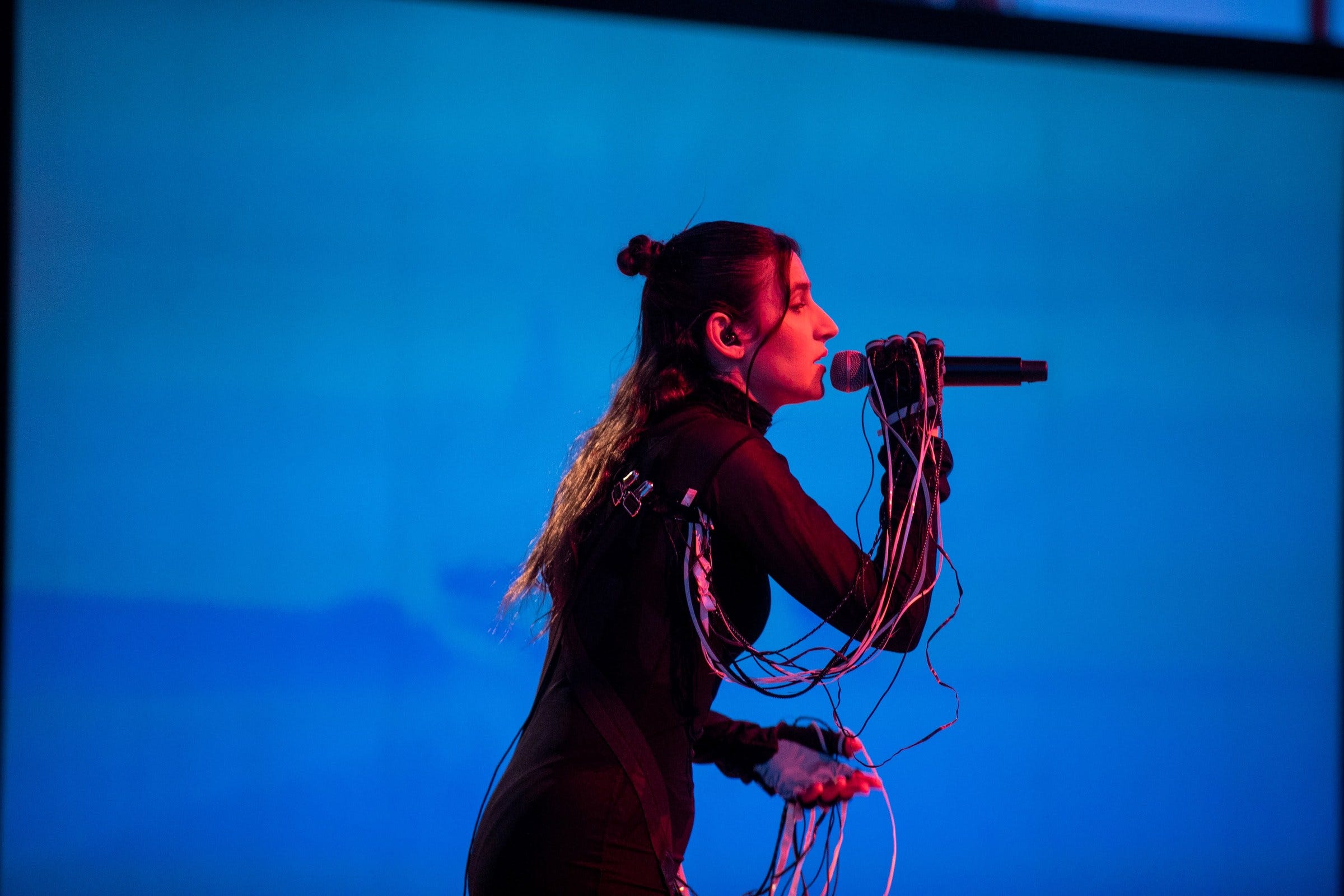
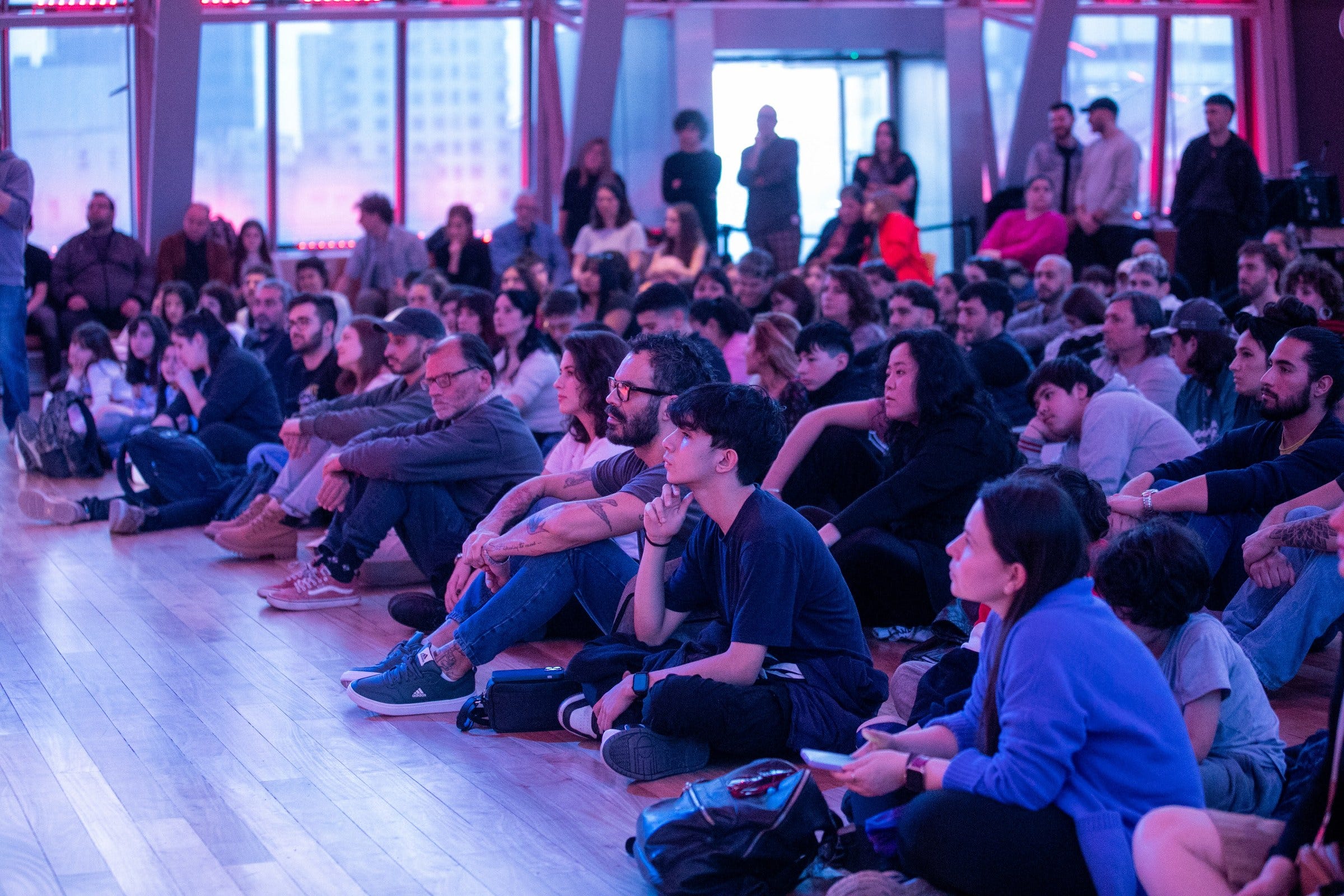
For fifteen days in the winter of 2024, the largest cultural center in Latin America belonged to a group of independent musicians who had met, mostly, on the internet. Palacio Libertad, the Buenos Aires landmark most people still call the CCK, gave them a floor. They filled it with an exhibition of on-chain music videos, an augmented-reality show, a collective release of new songs, and two nights of concerts, one acoustic, one electronic. More than 15,000 people came through.
The group is MusicaW3, a community of independent artists across Latin America, and the exhibition was called Resonancias Paralelas. Its co-founders, the artist and community builder Sol Siete and Gonzalo Perez Rojas, an electronic musician who performs as 0xGonzalo, describe it less as a triumph than a portrait. “One of the biggest events that we hosted is the best one to define the soul, the energy, and the artist of MusicaW3,” Sol says in the interview she recorded for this report.
Sol Siete's recorded interview for MusicaW3's Artizen impact report.
The Lesson Before the Lesson
MusicaW3 began three and a half years ago as something closer to a school: teach musicians to use blockchain tools to sell their work directly and stop waiting for a label. Somewhere in the teaching, the lesson underneath the lesson became the point.
“The platform changed a little bit and it's not just educational, it's more about understanding how to work in group,” she says. “You need a team, you need other musicians and artists to exist in a music scene. In cities or in towns and wherever you are, even in the internet, you need a community.”
“You never build alone.”
That sentence has organized the last few years of MusicaW3's work: monthly Collective Drops, coworking events that pair experienced musicians with newer ones, community calls moderated by volunteers in Venezuela and Córdoba, and a stage of its own at the Decentraland Music Festival, five days of Latin American artists playing inside a virtual world. In 2026 and 2027 the focus shifts to building tools that help musicians grow more sustainable and sovereign careers, and closer relationships with one another: festivals, collaboration tools, and a networking feed inside the club, MW3.club.


A Ticket from Chile
Ask Sol what the community has changed and she reaches not for a dashboard but for a person.
Brauxelion is a MusicaW3 member from Chile. When Devconnect, the Ethereum community's annual gathering, came to Buenos Aires in November 2025, MusicaW3 produced a side event and put him on the bill for two days. “We hosted him, we gave him a place to stay, and we gave him a work opportunity for him to pay the trip,” Sol says. “And he said to us recently that that changed his life a lot.”
Sandro, a musician and producer from Córdoba who helps moderate its groups and has played its stages from Pizza Day to the Decentraland Music Festival, keeps his own list. The first copy of one of his songs sold on a Collective Drop; ten more followed. A fellow member, Sielo, bought her first iPhone with what her songs earned.
“Thanks to them I can say that my career as an artist and producer has a future.”
By Sol's count, more than a hundred musicians have passed through since 2023. What they took away, she says, is less a product than a habit: they learned to collaborate with one another and found platforms beyond the streaming giants to distribute their music.
The People Who Stayed
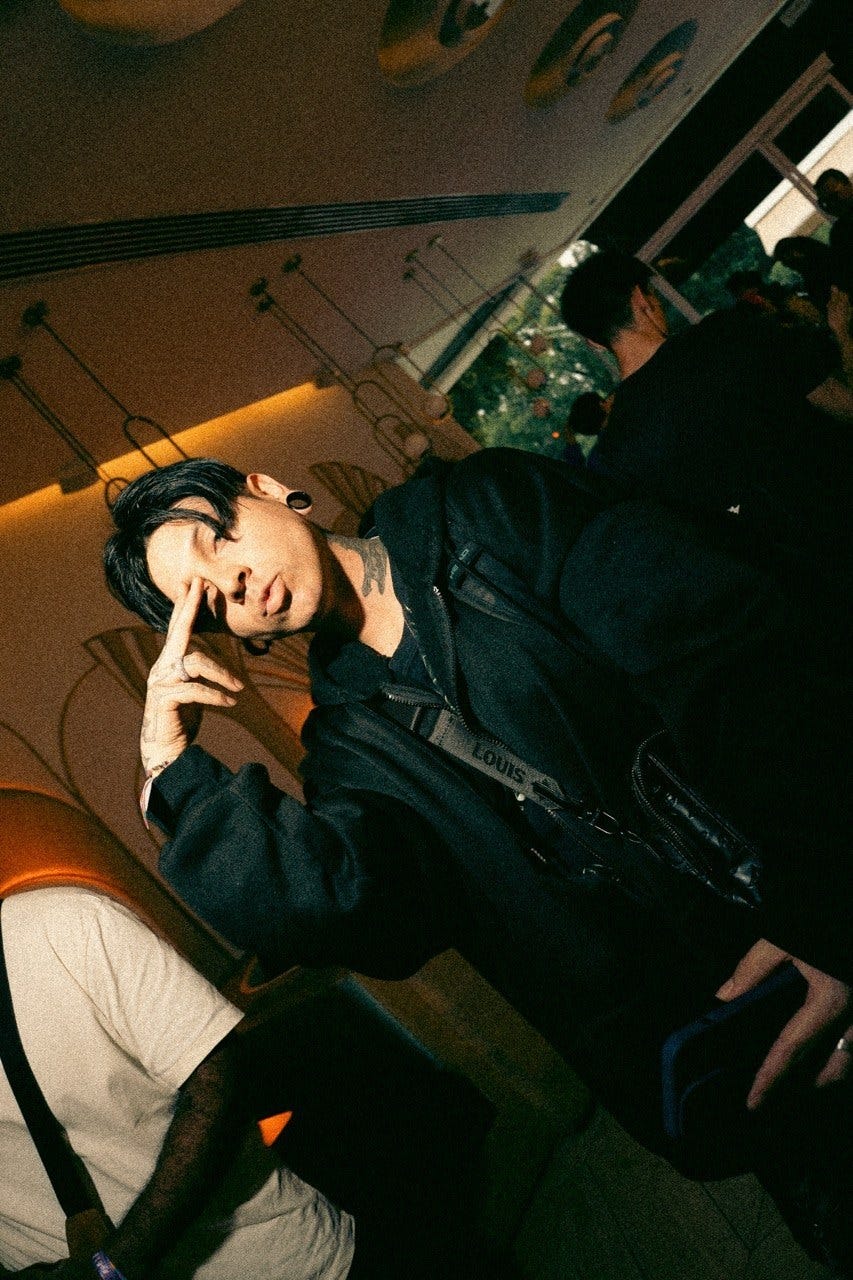
Nuria Dutt, an Argentine artist and composer and one of the community's earliest members, has played its live events and its collective drops. “MusicaW3 offers independent artists opportunities that are not easily accessible in the mainstream music industry, such as performing in important venues and providing tools to better communicate each project,” she says. “I've experienced this firsthand in my professional career, so I can say that the impact is real and positive.”
Isaac, who releases as W8W Withinthevacuum, has three years of Collective Drops in his wallet, and what he noticed was the rhythm. “I've seen the consistency of the community and its ability to bring people together,” he says.
Malbec, founder of the Metacorral community and a coordinator of PizzaDAO in Latin America, has worked alongside them for three or four years. “That commitment is the soul of the project,” he writes, in Spanish, “and it has earned them the trust of organizers and artists across the region.”


What the Money Bought
Through Artizen's Season 6, MusicaW3 raised $33,540.07: $18,980 in artifact sales from supporters, and over $14,000 in match funding unlocked through fund drives. Nearly all of it, by Gonzalo's written account, went to pre-production for something the community has never attempted at this scale: its own festival.
That meant building the native WOW!! mobile app, curating the lineup, developing the technology behind the augmented- and virtual-reality installations, negotiating venues, and opening conversations with sponsors. It produced two confirmed editions of WOW!! Festival. The community is also finishing MW3.club, a digital social club where members take on quests, earn rewards, and vote on-chain on proposals, including small grants for projects in a member's own city.
Three Floors, Free
The first WOW!! Festival opens in October 2026 at Dunepark, an art and technology hub in the heart of Villa Crespo, Buenos Aires: three floors of live music, interactive installations, digital art, and talks, free and open to the public, with a lineup drawn from local artists, technologists, public-goods advocates, and cultural organizations rather than a booking agency's roster. A second edition, planned for March 2027, is designed for 1,200 attendees.
“They are not alone, and they need to learn how to not compete and work in group.”
Gonzalo is candid that October is a prototype: a test of the app, the infrastructure, the curatorial model, and the idea that a festival can be produced by the community it serves.
The Room, Again
What Sol believes will change is not a chart position. “This will impact the world by changing musicians' mindsets about earning money from their work,” she says. “Musicians don't understand money or business, or they don't give value to their time or songs. And we are changing that little by little.”
If artists come to see their songs as things with value, and listeners have the tools to pay for them directly, the talent that has always been there gets a real chance at a career that lasts.
Explore MusicaW3 on Artizen. Follow the festival at festivalwow.xyz, join the community at mw3.club, and find the free onchain creators course at musicaw3.com.
This is fantastic René.
Love this !