


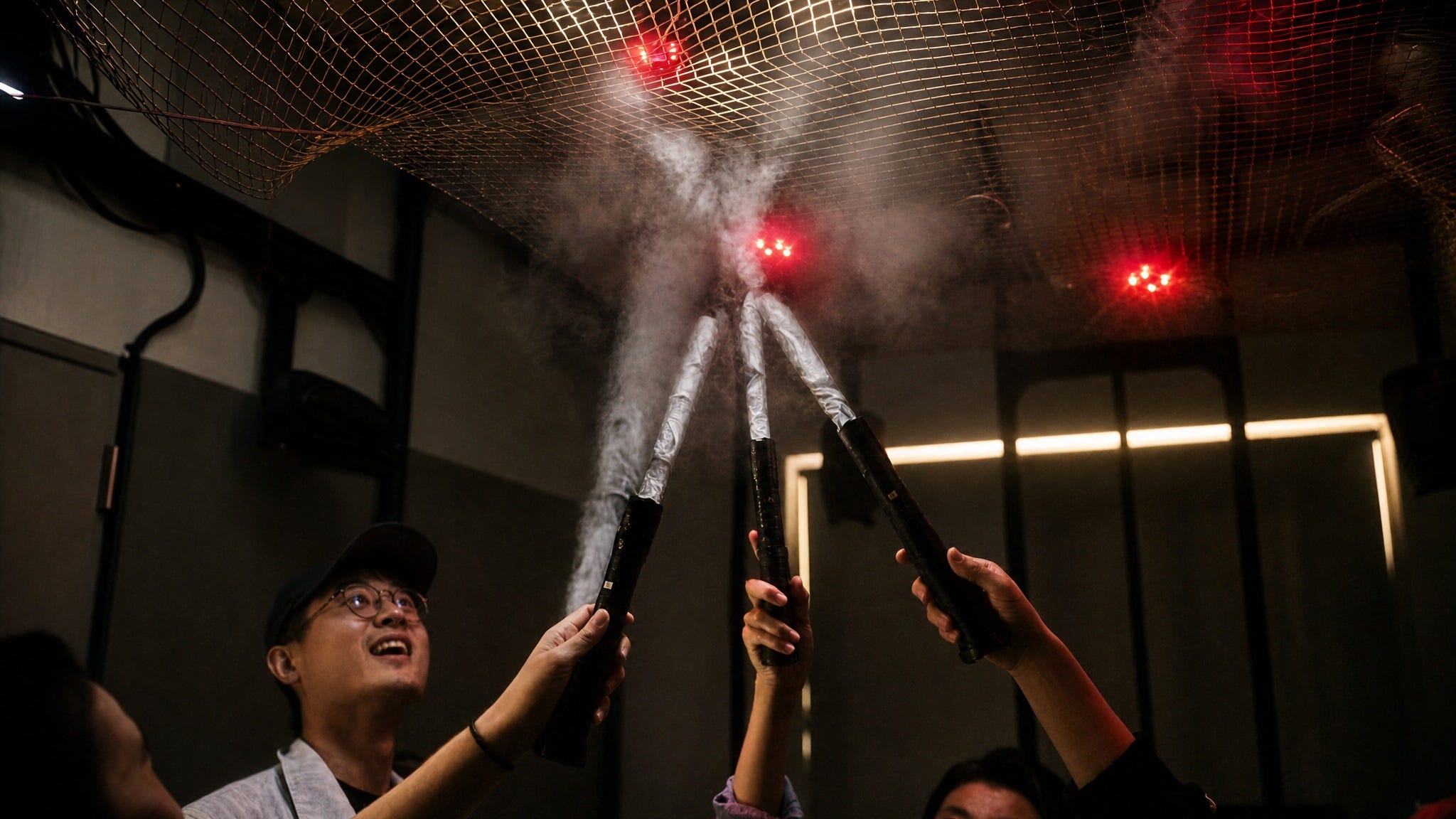
Hand someone a flashlight in a dark room with a net hanging overhead and they will do the same thing every time. “People, when given a flashlight, kind of do laser finger at first,” Summer Krinsky says. They wave it around. They point it at their friends. It takes a few seconds before they notice that every time the beam crosses one of the sensors in the net, a sound answers. A kick. A hat. A stab of synth, locked perfectly in time with everything else in the room. Then they stop waving and start playing.
That moment is the whole point of SampleRate, the interactive light-and-sound installation Summer has been building, breaking, and rebuilding for the better part of two years. The pitch is a single sentence: an audience-triggered rave. The mechanism is stranger and more elegant than that. Specially designed 3D-printed flashlights blink in subdivisions of a shared tempo. When their beams hit the photoresistor sensors woven into a net suspended above the crowd, they trigger arranged samples on the beat. Nobody is DJing. The room is.
Summer Krinsky on a year of SampleRate.
Summer is a musician first, a creative coder second, and by her own account she has lost track of which version she is on. “At this point it's been V2, V3, V4. I don't know, I've lost track of the Vs.” What she can track is the tour. Over this season SampleRate has hung at an Artizen gathering in Boulder, several times at Stanford's CCRMA, at the Computer History Museum in Mountain View, at the NIME conference in London, and now at the MSU Museum, where it opens on September 3 and stays up for months.
Copper tape, guitar cables, and the weight of a good idea
The very first hang was not glamorous. Spring 2025, Studio E at Stanford's Center for Computer Research in Music and Acoustics: hand-soldered protoboards, hand-made wiring with screw terminals, flashlights whose positive connection was held together with copper tape. “More of a proof-of-concept,” Summer says. It worked well enough to prove the idea and badly enough to make the next year inevitable.


Her answer to “what surprised you about doing your own hardware” is a list of small, honest defeats. The copper tape “would only hold for so long and then fall off, because it's tape.” So she started printing the flashlight bodies with conductive filament exactly at the contact points and non-conductive filament everywhere else, which introduced a new problem: swap filaments mid-print and the body cracks more easily. More iterations.
Then there were the cables. Her first clever idea was to run every sensor in the net on ordinary quarter-inch TRS guitar cables, three signal paths for power, ground, and the photoresistor reading, so that anyone could hang the piece anywhere and replace a broken cable from a music store. She designed the PCBs around it. Then she hung the net at ETH Boulder.
“It weighted the net down in a way that I really didn't like. It made it really hard to hang, and I didn't like how it looked.”
So she reprinted every board for eighth-inch connectors, the headphone-jack kind, and flipped the jack to the top of each sensor board so the net would pull taut instead of drooping. “That made a huge difference.” Every one of those decisions is visible in the piece today if you know where to look, and invisible if you don't, which is the definition of good hardware.
The deepest problem was time. SampleRate is a musical instrument, and instruments live or die on latency. Every sensor she added meant another analog light reading that had to be converted into a number before the hub could act on it. Her first fix, a multiplexer that let one microcontroller take turns reading many sensors, only made things slower, because every conversion still had to happen on the microcontroller itself. So she took the conversion off the chip entirely and handed it to a dedicated analog-to-digital converter, an MCP3208, which reads the light fast enough that every flashlight stays locked to the same clock.
“Figuring out how to keep things musical and have it happen with under 20 millisecond delay, so that people don't notice there's any time between the rhythm they're creating together.”
The hub is now its own custom board: a “sender” microcontroller that reads every sensor in real time while pushing rhythmically synced on-off pulses out to the “receiver” microcontroller inside each flashlight. Each flashlight has its own Max/MSP sequencer patch, and here is the detail that separates SampleRate from a very good light show: participants can edit those patches themselves. The net started with four sensors. It has run at eight. The current design has room for 24.
Learning without instructions
Ask Summer what the first audiences taught her and she does not talk about sound. She talks about mic stands.
One sensor, two ideas: beam intensity as a control, flashing as rhythm.
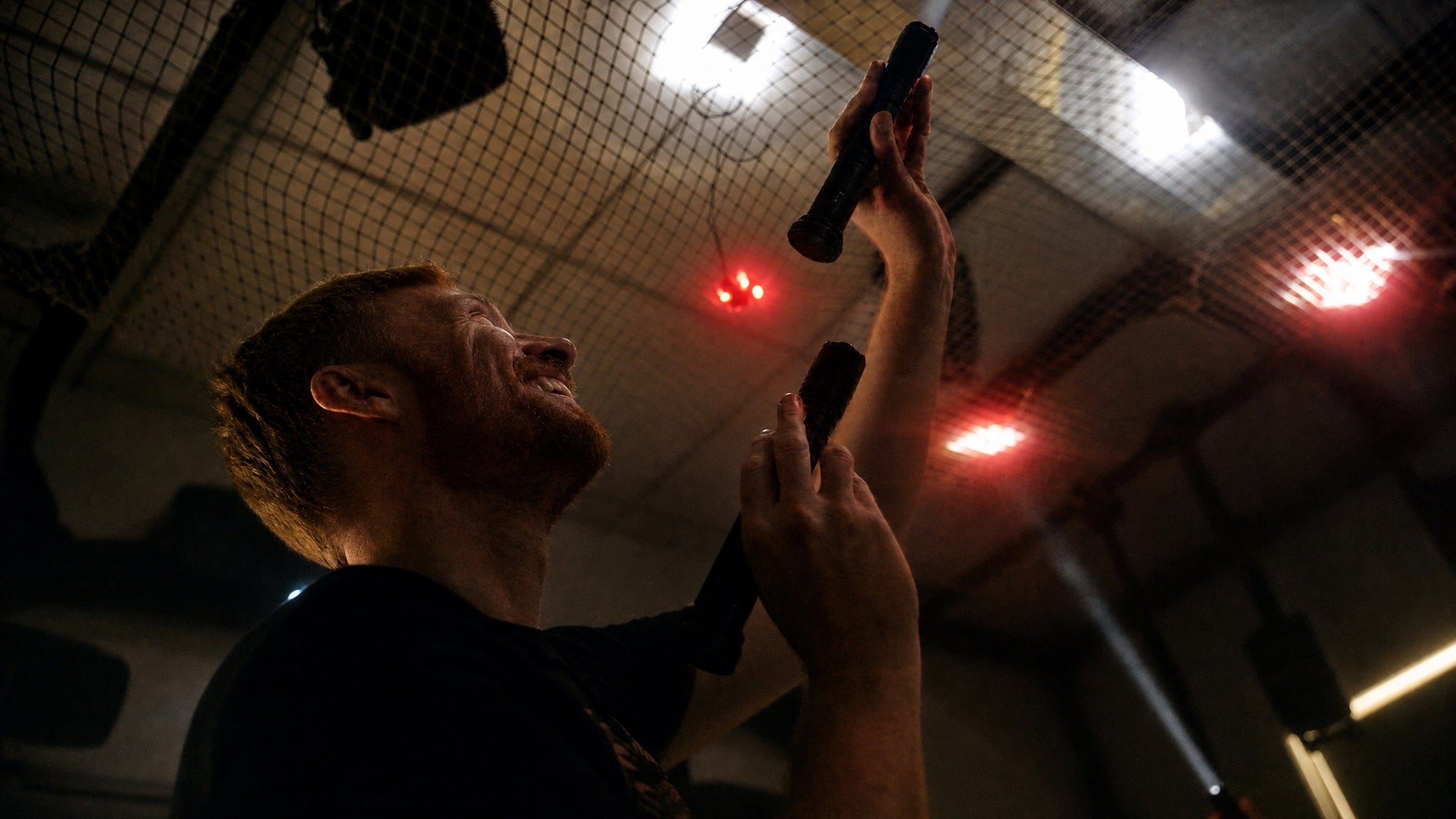
Watching people “laser finger” their way toward understanding, she realized the fastest teacher was a flashlight that was already playing. Every flashlight clips into a standard mic-stand clip, so now when you walk in there is usually one already parked on a stand, holding a beam on a sensor, laying down a steady rhythmic pulse. You hear the pattern before you make one. “That kind of expedites the process of learning,” she says. “It's obviously more fun to then be holding it and controlling it yourself.” You can also make slowly evolving music by simply moving the stands. Later iterations proved it: people put the interaction together far faster, without instructions, which was the goal all along.
“If they can figure it out on their own, then it's very rewarding.”
That is a design philosophy hiding inside a practical fix. No wall text, no docent required, no instructions. The piece teaches you how to play it by being played.
Boulder, Stanford, Mountain View, London
The first version that could survive a room full of strangers went up at ETH Boulder in February 2026, at an Artizen gathering. This was a crowd who had never heard of her, holding flashlights, working out the rules together with nobody explaining them. It held. The year that followed was a tour of rooms that kept getting bigger.
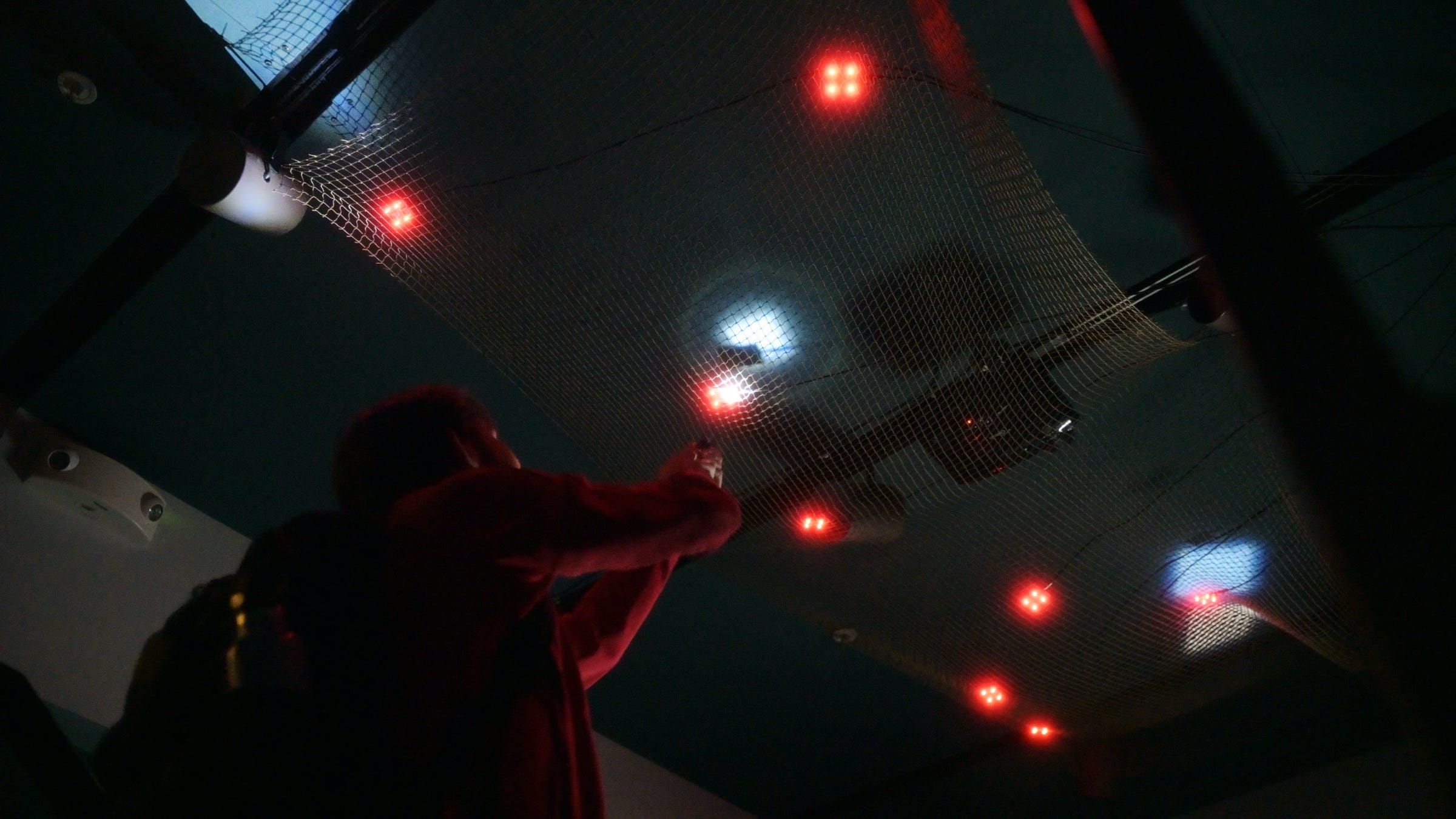
From Boulder it went back to CCRMA, several times, changing a little each hang: more sensors, more sounds, and a long argument with herself about restraint. “How to put more sensors in but not let it feel overwhelming. What's too many sounds? What's too little sounds? How to make it feel as playable as possible.”
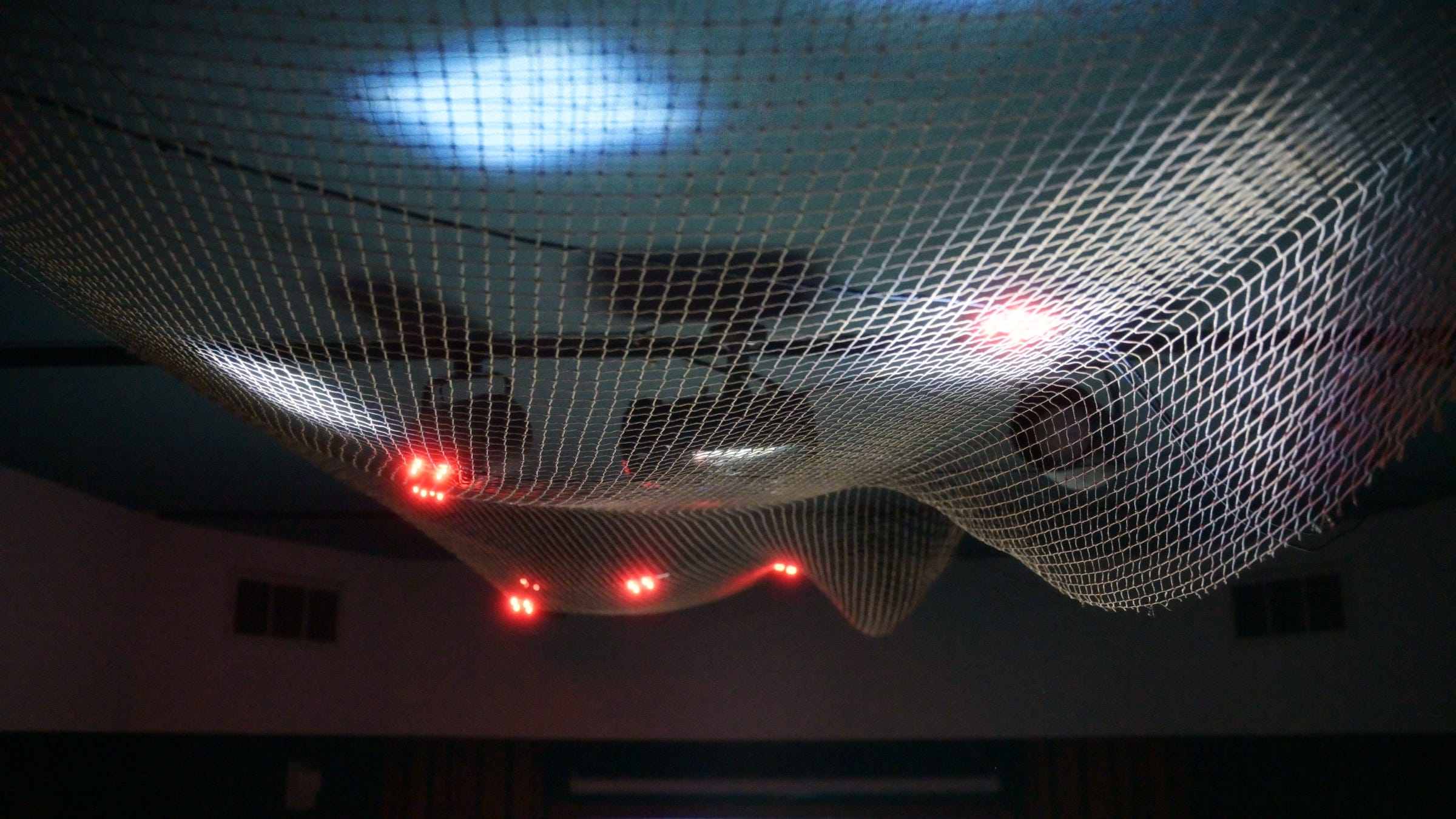
Then the Computer History Museum in Mountain View. Then London, for NIME, the New Interfaces for Musical Expression conference, “which is awesome because people are really into this kind of thing.”
Four strangers, four flashlights, one groove at NIME London.
Each of those was a one-day hang, a test under different conditions. The museum run is the real experiment. “The museum context is a cool testing ground,” she wrote in her report, “because you get people of all ages and backgrounds wandering in.” The MSU Museum keeps guides on the floor, which matters for a piece that is far better with two people than one. “If they come in alone, it's not as fun as when you play with someone else. So there will always be someone there that can show them how to use it and also play with them.” The museum has already told her they expect it to be a kid favorite.
“It's like the opposite of ‘don't touch the art.’ You make the art.”
What she wants you to leave with
“Surprise, I think, is rare to feel as an adult. Often you feel like you've experienced everything there is, which of course is not true, but you have less new experiences. That's what I love about interactive installation: you give people a surprising experience through sensory engagement that they won't forget, because it is different.”
Summer hopes people who have never thought of themselves as musical walk out feeling like they just performed with their friends, because they did. She hopes some of them go make something. And she has a theory about why that matters that goes past art. “When you feel that a piece of art has moved you, it makes you engage more with other creative communities and want to seek that feeling out again. It makes you think differently. It makes you more open. And we have to constantly open ourselves back up so that we're not hardening as people.”
What the funding built
SampleRate is one of the most-funded projects of Artizen's Season 6. Through Artizen it has raised $77,732.21 to date: $27,290 in artifact sales, $20,682.21 in match funding from the three curated funds that selected it (the Resonate Fund for Sonic Pioneers, the MultiMax Fund for Immersive Interaction, and the Fund of Infinite Yes), and $29,760 in boost awards from sprints and match boosts.
The hardware, Summer says, finally “feels more solidified,” which means she can turn to the part she has been waiting for. Right now the music changes mostly because people play it differently. She wants it to change on its own too, morphing slowly through textures so that a room three minutes in sounds nothing like the room at minute one. And once the installation is reliable enough to survive a crowd that is not gentle, she wants to take it where crowds are not gentle: music festivals with installation programs like Electric Forest, Movement, and Burning Man. “I feel like it's very close to being there.”
SampleRate installed across several locations.
She closed her interview the way she closes most things, quickly and sincerely. “Thanks René, thanks Artizen, thanks to this community for supporting these projects. I'm eternally grateful, really.”
The room, meanwhile, is still playing.
Explore SampleRate on Artizen. SampleRate is on view at the MSU Museum's “Reality Check” exhibition from September 3, 2026. Follow Summer's music as Summer Like The Season.
AMAZING genius Creators.