


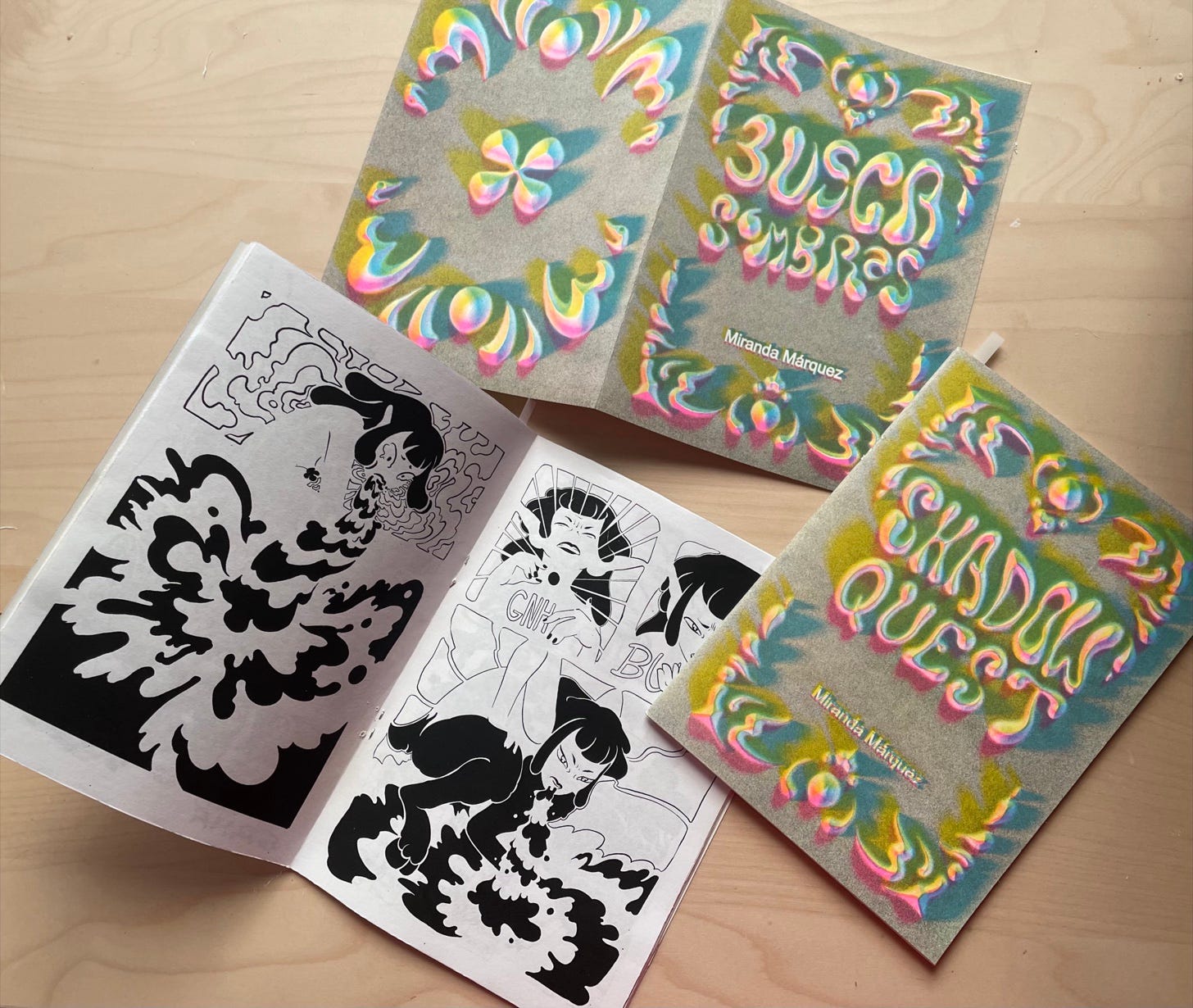
Halfway through the first chapter of the Shadowquest, a girl with flowers growing from her chest asks her armored friend why he never takes the helmet off. “It’s not to protect me,” he tells her. “It’s to protect others. My skin is made of shadows. Shadows scare people.”
Fantasy has always been literature's way of telling the truth at an angle. Name a wound too plainly and it flattens into case study; circle it too vaguely and it disappears. The Shadowquest, a hand-drawn comic book by the Spanish artist Miranda Marquez, walks straight at that problem in black and white ink: a fantasy about trauma and healing told through two characters who have to decide whether being seen is survivable.
“I am making the Shadowquest, which is a comic book with two main characters,” Marquez says in the interview she recorded for this piece. “Fauna, a fauna-like being with flowers in her chest, and Hombra, whose skin is made of shadows. It’s a fantasy setting with deeper symbolic meanings and a distinctive black and white style with psychedelic elements.”
Miranda Marquez, who wrote, drew, and printed chapter one herself.
A story told at an angle
Ask Marquez what the book is about and she does not reach for plot. She reaches for the reasons people armor themselves: “the fear of being seen for who we truly are,” she says, and its inverse, “how our shadows might actually contain hidden power.”
“How we hide ourselves, thinking that we will harm others.”
That is the engine of the story. Fauna sees in the dark and is not afraid of it. Hombra has spent so long convinced that his true face will scatter anyone who looks at it that he has built a life inside a suit of armor. Their friendship, drawn in inked panels threaded with symbolic detail, moves toward a single question, and the first chapter builds to the page where it gets answered.
The pages themselves carry the argument. In one early sequence the two race across a field, all speed and joy; a few pages later the same lightness turns careful, as Fauna asks about the armor and the panels slow to hold the silence between her questions.


From hand-written pages to print
Marquez has been building the Shadowquest on Artizen across three seasons, and this is the season it stopped being a promise. “The project moved from pure storyboard into real, physical form,” she writes in her impact report. The entire first chapter is finished, printed, and bound, in two editions: Shadowquest in English and Buscaombres in Catalan.
The remaining chapters exist the old way, as a hand-written draft awaiting formatting and lettering. There is something fitting about a story on trauma and healing being drafted by hand first: slow work, done at the speed of the body. “It’s a labor-intensive process, page by page,” she writes.
She is candid that drawing turned out to be the smaller half of the job. “The biggest thing I’ve learned this season is how to plan and manage a project with this many moving parts: from thumbnails and page layout, to inking, lettering, print imposition and binding, all the way to distribution.”
“Bringing a comic from a loose idea into a printed, shareable object takes a completely different kind of organization than illustration alone.”
Illustration is a skill; a book is a system. Learning to run the system without losing the hand that draws it is the unglamorous growth that separates projects that stay dreams from projects that reach readers. The printed chapter now has a job to do: Marquez is sending it to small independent publishers, and reorganizing her life to give the book the full-time attention inking a comic demands.
The engineer who draws
Marquez came to comics sideways, which may be why the book feels engineered as much as drawn. She holds a degree in Multimedia Engineering from La Salle in Barcelona, trained in comics at Escola Joso, is a certified 3D printing technician, and spent seven years working as a fashion model. Her interactive installations have shown at Sonar+D, the art-and-technology wing of Barcelona’s Sónar festival. “I have a really unique style and a really unique narrative pattern,” she says. The psychedelic riso-printed covers and the stark interior ink are not borrowed from anyone.
Christopher Rose, project backer and one of the book’s first readers, puts it plainly: “They’re an amazing artist and also technologist, working in many interesting ideas to boot.” Rose sees the printed chapter as an entry into something larger. “The local zine scene has always been an amazing distribution network for underground and unfriendly artists, and here in Europe there’s a lot going on, so I’m excited to see where it all evolves.”
The book was also built to live in more than one language from the start. Mireia Ibáñez Cid, the professional Catalan translator behind the Buscaombres edition, describes the work this way:
It has been a delight to be part of Miranda’s project. The Shadowquest pairs imaginative, eerie illustrations with the big, thought-provoking questions layered beneath the surface of so many children’s stories, and it has been an honour to help Miranda convey this into my own language, Catalan.


What the community unlocked
“The first chapter has been sent to over 12 people that had already supported me,” Marquez says, “and the first reads had really good feedback. I’m really happy about it.” Those readers are the same community that funded the book into existence.
The Shadowquest by the numbers. $14,743 raised across three seasons against a $6,000 goal: 246% funded, and still climbing in Season 7.
That money bought real things: a printed chapter, printed backer rewards, and the breathing room to restructure a working life around finishing a book. Comics are among the most labor-dense art forms per finished page. Community funding is what lets an independent artist choose depth over speed, and Marquez is clear about where she wants it to lead.
“I hope I can make it happen full time soon.”
The helmet comes off
The page the whole first chapter builds toward is the one where Hombra finally takes off the helmet. Fauna looks at the shadow-face underneath, the thing he was certain would drive her away, and says: “How could I ever be scared of you? You’re so beautiful.”
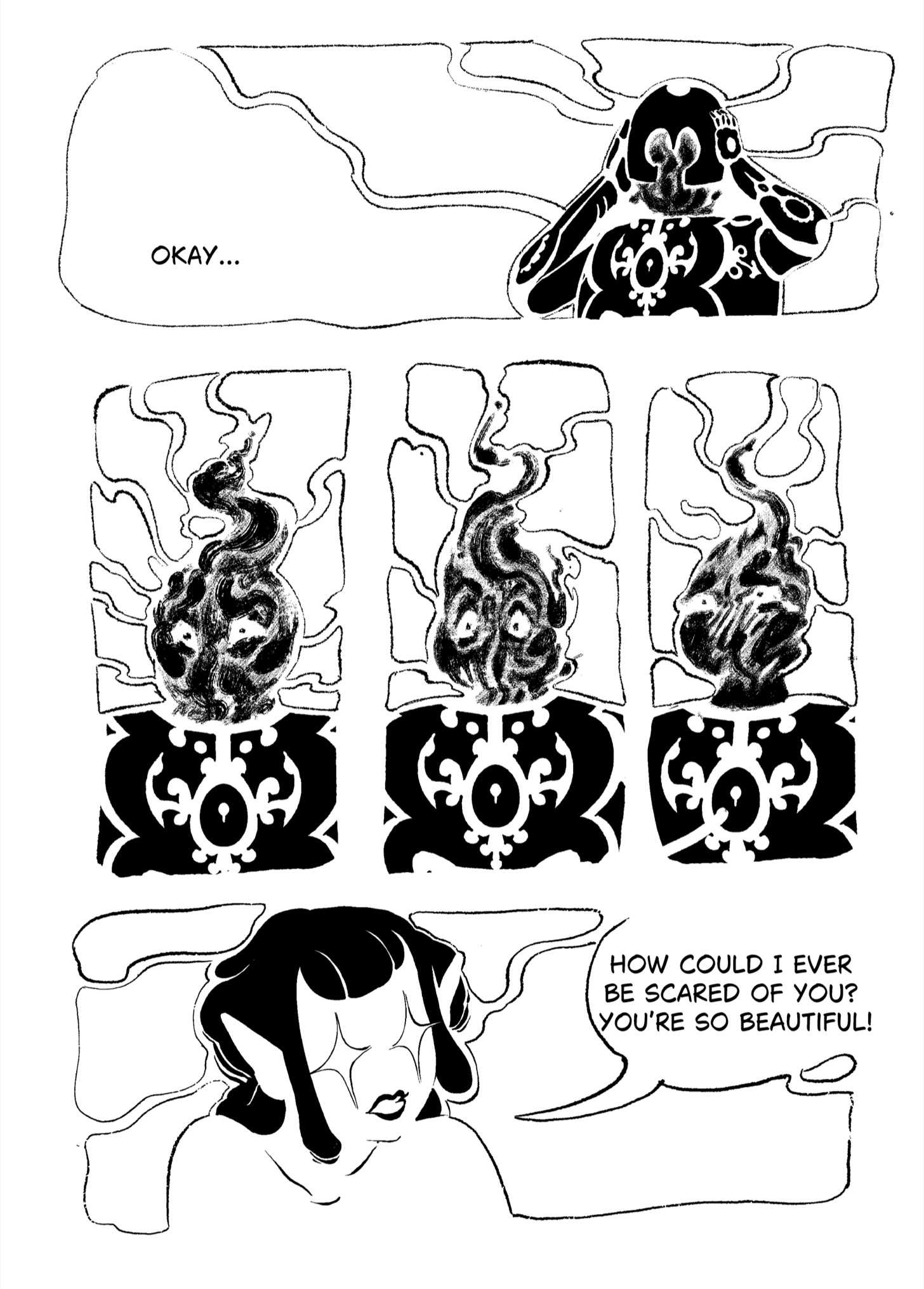
That is the wager of the Shadowquest: that healing is not the absence of shadow but the willingness to be seen holding one. Chapter one exists now, in print, in two languages, in the hands of its first readers. The rest of the story is waiting in a hand-written draft, and its author is reorganizing her life to ink it.
The armor, page by page, is coming off.
Explore the Shadowquest on Artizen, see more of Miranda's work at mirandamarquez.es, and follow her on Instagram. Interview answers lightly edited for clarity.